 Add to Chrome
 Add to Firefox
 Add to Edge
Realizing Immersive Volumetric Video: A Multimodal Framework for 6-DoF VR Engagement
Apr 10, 2026
Fully immersive experiences that tightly integrate 6-DoF visual and auditory interaction are essential for virtual and augmented reality. While such experiences can be achieved through computer-generated content, constructing them directly from real-world captured videos remains largely unexplored. We introduce Immersive Volumetric Videos, a new volumetric media format designed to provide large 6-DoF interaction spaces, audiovisual feedback, and high-resolution, high-frame-rate dynamic content. To support IVV construction, we present ImViD, a multi-view, multi-modal dataset built upon a space-oriented capture philosophy. Our custom capture rig enables synchronized multi-view video-audio acquisition during motion, facilitating efficient capture of complex indoor and outdoor scenes with rich foreground--background interactions and challenging dynamics. The dataset provides 5K-resolution videos at 60 FPS with durations of 1-5 minutes, offering richer spatial, temporal, and multimodal coverage than existing benchmarks. Leveraging this dataset, we develop a dynamic light field reconstruction framework built upon a Gaussian-based spatio-temporal representation, incorporating flow-guided sparse initialization, joint camera temporal calibration, and multi-term spatio-temporal supervision for robust and accurate modeling of complex motion. We further propose, to our knowledge, the first method for sound field reconstruction from such multi-view audiovisual data. Together, these components form a unified pipeline for immersive volumetric video production. Extensive benchmarks and immersive VR experiments demonstrate that our pipeline generates high-quality, temporally stable audiovisual volumetric content with large 6-DoF interaction spaces. This work provides both a foundational definition and a practical construction methodology for immersive volumetric videos.

ImViD: Immersive Volumetric Videos for Enhanced VR Engagement
Mar 18, 2025User engagement is greatly enhanced by fully immersive multi-modal experiences that combine visual and auditory stimuli. Consequently, the next frontier in VR/AR technologies lies in immersive volumetric videos with complete scene capture, large 6-DoF interaction space, multi-modal feedback, and high resolution & frame-rate contents. To stimulate the reconstruction of immersive volumetric videos, we introduce ImViD, a multi-view, multi-modal dataset featuring complete space-oriented data capture and various indoor/outdoor scenarios. Our capture rig supports multi-view video-audio capture while on the move, a capability absent in existing datasets, significantly enhancing the completeness, flexibility, and efficiency of data capture. The captured multi-view videos (with synchronized audios) are in 5K resolution at 60FPS, lasting from 1-5 minutes, and include rich foreground-background elements, and complex dynamics. We benchmark existing methods using our dataset and establish a base pipeline for constructing immersive volumetric videos from multi-view audiovisual inputs for 6-DoF multi-modal immersive VR experiences. The benchmark and the reconstruction and interaction results demonstrate the effectiveness of our dataset and baseline method, which we believe will stimulate future research on immersive volumetric video production.
Polar R-CNN: End-to-End Lane Detection with Fewer Anchors
Nov 03, 2024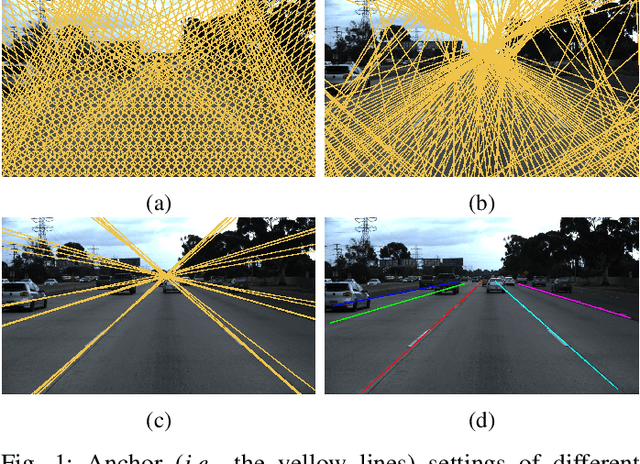
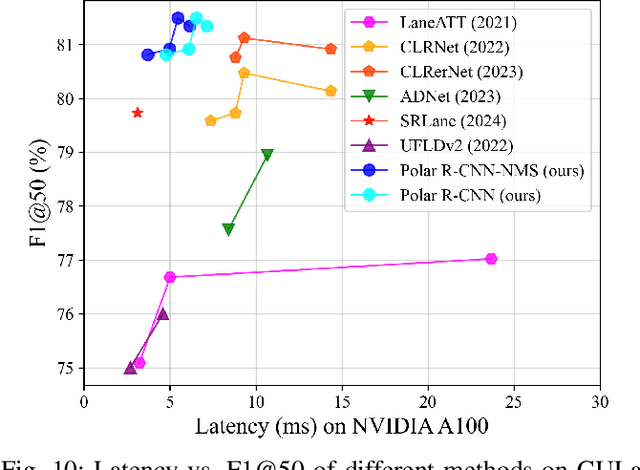

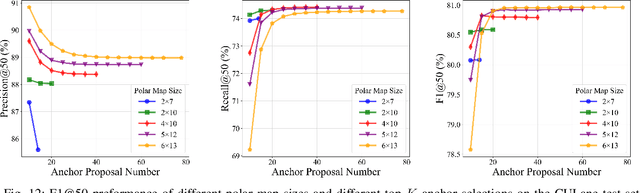
Lane detection is a critical and challenging task in autonomous driving, particularly in real-world scenarios where traffic lanes can be slender, lengthy, and often obscured by other vehicles, complicating detection efforts. Existing anchor-based methods typically rely on prior lane anchors to extract features and subsequently refine the location and shape of lanes. While these methods achieve high performance, manually setting prior anchors is cumbersome, and ensuring sufficient coverage across diverse datasets often requires a large amount of dense anchors. Furthermore, the use of Non-Maximum Suppression (NMS) to eliminate redundant predictions complicates real-world deployment and may underperform in complex scenarios. In this paper, we propose Polar R-CNN, an end-to-end anchor-based method for lane detection. By incorporating both local and global polar coordinate systems, Polar R-CNN facilitates flexible anchor proposals and significantly reduces the number of anchors required without compromising performance.Additionally, we introduce a triplet head with heuristic structure that supports NMS-free paradigm, enhancing deployment efficiency and performance in scenarios with dense lanes.Our method achieves competitive results on five popular lane detection benchmarks--Tusimple, CULane,LLAMAS, CurveLanes, and DL-Rai--while maintaining a lightweight design and straightforward structure. Our source code is available at https://github.com/ShqWW/PolarRCNN.
FFINet: Future Feedback Interaction Network for Motion Forecasting
Nov 08, 2023Motion forecasting plays a crucial role in autonomous driving, with the aim of predicting the future reasonable motions of traffic agents. Most existing methods mainly model the historical interactions between agents and the environment, and predict multi-modal trajectories in a feedforward process, ignoring potential trajectory changes caused by future interactions between agents. In this paper, we propose a novel Future Feedback Interaction Network (FFINet) to aggregate features the current observations and potential future interactions for trajectory prediction. Firstly, we employ different spatial-temporal encoders to embed the decomposed position vectors and the current position of each scene, providing rich features for the subsequent cross-temporal aggregation. Secondly, the relative interaction and cross-temporal aggregation strategies are sequentially adopted to integrate features in the current fusion module, observation interaction module, future feedback module and global fusion module, in which the future feedback module can enable the understanding of pre-action by feeding the influence of preview information to feedforward prediction. Thirdly, the comprehensive interaction features are further fed into final predictor to generate the joint predicted trajectories of multiple agents. Extensive experimental results show that our FFINet achieves the state-of-the-art performance on Argoverse 1 and Argoverse 2 motion forecasting benchmarks.